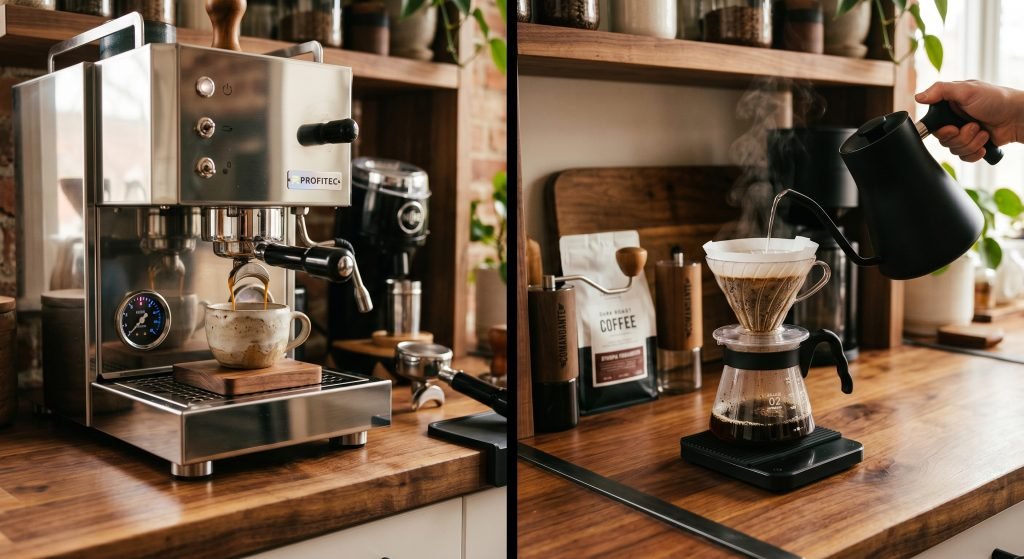
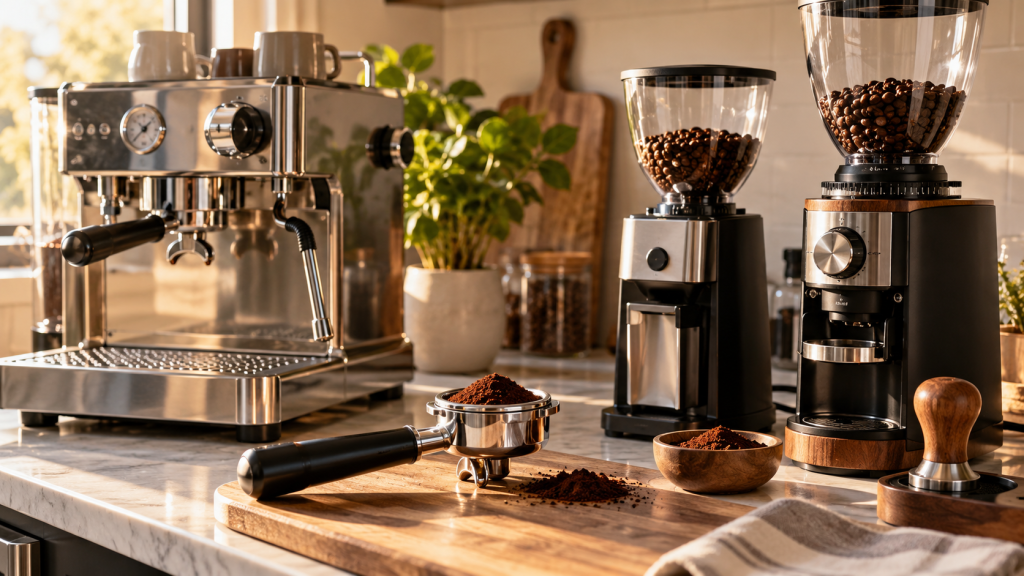
Do You Really Need an Expensive Coffee Grinder for Espresso?

f you’re building a home espresso setup, there’s a good chance you’ve wondered whether you should spend more on the espresso machine—or the grinder.

A $1,000 espresso machine paired with a mediocre grinder can still produce disappointing espresso.

Meanwhile, a reasonably priced espresso machine paired with a capable grinder can produce surprisingly good coffee.

So, do you really need an expensive coffee grinder for espresso?

Not necessarily.

For most beginners, you don’t need to spend $500 or $1,000 on a grinder. What you really need is a grinder that can produce a sufficiently fine and consistent grind and give you enough control to dial in your espresso.

In this guide, we’ll compare five grinders across different budgets, brewing styles and levels of espresso experience—and explain where spending more actually makes sense.


Quick Answer: How Much Should You Spend on an Espresso Grinder?

For most home baristas, I’d look at these ranges:

BudgetWhat You Can ExpectBest For
Under $100Basic manual grindingVery tight budgets
$100–$200Capable entry-level grindingBeginners
$200–$300Better electric and manual optionsMost home baristas
$300–$500More refinement and workflow featuresEnthusiasts
$500+Premium performanceSerious espresso hobbyists

For most beginners, $150–$300 is the sweet spot.

You don’t need to spend more on your grinder than your espresso machine just to make good coffee.

In fact, the bigger mistake is often buying an expensive machine and then pairing it with a grinder that doesn’t give you enough control.

If you’re working with a limited overall budget, our guide to building a $200 espresso setup looks at how to balance your machine, grinder and accessories without overspending on one component.


Why Does the Grinder Matter So Much for Espresso?

Espresso is extremely sensitive to grind size.

If the coffee is too coarse, water can pass through the puck too quickly. The result can taste thin, weak or sour.

If it’s too fine, the shot can become extremely slow and potentially taste harsh or bitter.

That’s why an espresso grinder needs to give you enough control to find the right setting.

But here’s something beginners often misunderstand:

More grind settings don’t automatically mean a better grinder.

A grinder with 60 settings isn’t necessarily better than one with 40.

What matters is whether those adjustments are useful for espresso and whether the grinder can produce reasonably consistent grounds.

And the grinder isn’t the only variable.

Water temperature, pressure, basket quality and puck preparation all matter too. If you’re curious about the machine side of espresso consistency, our guide to why espresso machines need PID explains why temperature stability matters.

5 Coffee Grinders Worth Considering

1. Baratza Encore ESP — Best Overall for Espresso

The Baratza Encore ESP is one of the grinders that makes the argument for not spending a fortune.

It was designed specifically to improve espresso performance over traditional entry-level grinders.

The Encore ESP uses 40mm conical steel burrs and provides 40 grind settings. The first 20 settings are aimed at espresso, while the remaining range covers coarser brewing methods.

That makes it particularly attractive if you want one grinder for both espresso and filter coffee.


Why we like it

  • Espresso-focused adjustment range
  • 40mm conical steel burrs
  • Simple and straightforward controls
  • Suitable for beginners
  • Can also handle filter coffee
  • Strong value for the money

The biggest advantage is that it does not try to overcomplicate the experience.

You can spend more on a grinder, but for someone making their first serious home espresso setup, the Encore ESP already gives you enough control to learn how grind size affects extraction.

Who should buy it?

Choose the Encore ESP if:

  • You are new to espresso
  • You want strong value
  • You don’t need an elaborate workflow
  • You make both espresso and filter coffee
  • You want to keep more money available for better beans or an espresso machine

Verdict: ★★★★★

For most beginners, this is the point where spending more starts to become a question of preference rather than necessity.

Where to Buy

2. Breville Dose Control Pro — Best for Convenience

The Breville Dose Control Pro takes a different approach.

Instead of focusing purely on enthusiast-style manual control, it is designed around convenience and repeatability.

It offers a wide range of grind settings and a built-in dosing system, making it appealing to people who want a relatively straightforward morning routine.

If you are making espresso before work and don’t want to spend several minutes weighing and adjusting every dose manually, that convenience can be meaningful.

Why we like it

  • Built-in dosing functionality
  • Large adjustment range
  • Easy to use
  • Good option for everyday home coffee
  • Suitable for espresso and other brewing methods

The trade-off is that serious espresso enthusiasts may eventually want more precise control than this grinder provides.

But for a beginner who values convenience, that may not matter at all.

Who should buy it?

Choose the Dose Control Pro if:

  • Convenience is important
  • You don’t want a complicated workflow
  • You make coffee regularly for yourself or your family
  • You want a grinder that can handle multiple brewing methods

Verdict: ★★★★☆

A practical choice for everyday coffee rather than a grinder aimed purely at espresso perfection.

Where to Buy

3. OXO Brew Conical Burr Grinder — Best for Everyday Coffee

The OXO Brew Conical Burr Grinder is an interesting choice if espresso isn’t the only coffee you drink.

It is designed as a versatile home grinder, making it suitable for people who move between espresso, drip coffee, pour-over and other brewing methods.

The appeal here is simplicity.

You don’t necessarily need an espresso-focused grinder if your morning routine changes from day to day.

Why we like it

  • Straightforward controls
  • Conical burr design
  • Wide range of brewing applications
  • Good option for everyday coffee drinkers
  • Relatively accessible price

The important distinction is that this is more of an all-purpose home grinder than a dedicated espresso enthusiast grinder.

If espresso is your only priority, there are better options.

If you regularly switch between different brewing methods, however, the OXO becomes much more attractive.

Who should buy it?

Choose the OXO if:

  • You make different types of coffee
  • You want something simple
  • Espresso is important but not your only brewing method
  • You don’t want to spend heavily on a specialist grinder

Verdict: ★★★★☆

A sensible choice for households where one grinder needs to do several jobs.


Where to Buy

4. Fellow Opus — Best Design + Multi-Brew Option

f you want something more refined without moving into extremely expensive territory, the Fellow Opus 2 is worth considering.

The Opus 2 is designed to cover a wide range of brewing methods, including espresso.

What makes it interesting is the combination of its burr system and adjustment mechanism.

The grinder gives you much more control than a basic entry-level grinder while still working well as an all-purpose home grinder.

Fellow Opus 2 Conical Burr Grinder in matte black—minimalist and ideal for pour-over coffee.

Why we like it

  • 48mm conical burrs
  • Espresso capable
  • Very wide brewing range
  • Fine adjustment control
  • Low-retention design
  • Premium workflow
  • Good for households using multiple brewing methods

This is the type of grinder that makes sense when you know you are going to use it frequently.

It isn’t simply about getting better espresso.

It is about having a grinder that feels more refined every time you use it.

Who should buy it?

Choose the Opus 2 if:

  • You want espresso and filter capability
  • You care about workflow
  • You want a more premium grinder
  • You expect to experiment with different brewing methods
  • You are willing to spend more for convenience and control

Verdict: ★★★★½

A strong middle ground between entry-level equipment and enthusiast-level grinders.

Where to Buy

5. 1Zpresso J-Ultra — Best Manual Espresso Alternative

Not everyone needs an electric grinder.

For someone who only makes one or two espresso drinks at a time, a high-quality manual grinder can actually be a very smart purchase.

The 1Zpresso J-Ultra is specifically designed with espresso in mind and uses extremely fine adjustment increments.

That makes it possible to make very small changes while dialing in a shot.

The downside is obvious:

You have to turn the handle yourself.

But there is another side to that.

A good manual grinder gives you a surprisingly high level of control without requiring a large motor, expensive electronics or a bulky countertop appliance.

1Zpresso manual coffee grinder set in dark navy/black with textured body, folding silver handle, and dark wood knob. Includes carrying case with red logo, cleaning brush, air blower, and rubber collar accessory.

Why we like it

  • Espresso-focused design
  • Very fine adjustment
  • Excellent control
  • Compact footprint
  • No electrical connection required
  • Strong option for serious espresso enthusiasts

If you are interested in manual espresso grinding, you can also read [our 1Zpresso J-Ultra review].

Who should buy it?

Choose the J-Ultra if:

  • You make one or two drinks at a time
  • You enjoy a hands-on workflow
  • Counter space is limited
  • You want very precise espresso adjustment
  • You don’t mind manually grinding your coffee

Verdict: ★★★★½

One of the better choices for someone who cares more about espresso control than speed.


Where to Buy
Espresso Grinder Comparison

GrinderBest ForEspresso ControlBrewing RangeWorkflow
Baratza Encore ESPBeginners★★★★☆★★★★☆★★★★☆
Breville Dose Control ProConvenience★★★★☆★★★★☆★★★★½
OXO Brew Conical BurrEveryday coffee★★★½☆★★★★★★★★★½
Fellow Opus 2Multi-brew users★★★★½★★★★★★★★★½
1Zpresso J-UltraManual espresso★★★★★★★★☆☆★★★☆☆

These ratings are not intended to suggest that one grinder is universally better than another.

They simply show where each grinder makes the most sense.


So, Do You Really Need an Expensive Coffee Grinder for Espresso?

For most home users, no.

You need a good grinder.

You don’t necessarily need an expensive grinder.

There is a big difference.

If you are just starting out, I would rather see you spend your money on a balanced setup than put most of your budget into one premium grinder.

For example, a $200–$300 grinder paired with a sensible espresso machine can be a much better overall setup than a $600 grinder paired with a mediocre machine.

This is especially important when you are still learning how to dial in espresso.

You may not even be able to take advantage of the extra performance of a premium grinder yet.


When Is It Worth Spending More?

There are situations where a more expensive grinder absolutely makes sense.

You change coffee beans frequently

Different beans can require noticeably different grind settings.

A grinder with more precise adjustment can make this process easier.

You prefer light-roasted specialty coffee

Light roasts can be more difficult to extract.

They often reward greater control over grind size and extraction.

You make several espresso drinks every day

If you use your grinder five or ten times a day, workflow becomes much more important.

A faster, cleaner and more consistent grinder can save a surprising amount of time.

You care about consistency

If you’re chasing repeatable espresso shots, better burrs and mechanical precision become increasingly valuable.

You are already happy with your espresso machine

Once your machine, basket and overall workflow are already sorted, upgrading the grinder may produce a more noticeable improvement than upgrading another accessory.


Where Your Money Matters More Than You Think

One mistake I see frequently in home espresso setups is spending too much on the machine and too little on the grinder.

But the opposite can also happen.

Buying a $700 grinder doesn’t automatically make a $200 espresso machine produce $700-level espresso.

The goal should be balance.

Think about your setup as a system:

Machine + Grinder + Coffee + Basket + Technique

All five affect the final cup.

For example, upgrading your espresso basket can sometimes be more useful than simply buying a more expensive grinder. If you’re interested in extraction, take a look at our guide to [high-extraction espresso baskets].

Likewise, if you’re trying to improve shot consistency, a bottomless portafilter can be a useful diagnostic tool. We’ve covered that in our [bottomless portafilter guide].

And if you’re still deciding how much to spend on the machine itself, our [affordable home coffee setup guide] is a good place to start.


What About Grind-by-Weight?

Another feature that is becoming increasingly popular is grind-by-weight.

Instead of grinding for a fixed amount of time, the grinder uses a built-in scale to stop once it reaches your target dose.

This can make your workflow more repeatable.

However, it doesn’t automatically mean better-tasting coffee.

A grinder with excellent burrs and precise adjustment can still outperform a grind-by-weight grinder with mediocre grinding performance.

If you want to understand whether this feature is actually useful, see our [guide to grind-by-weight coffee grinders].


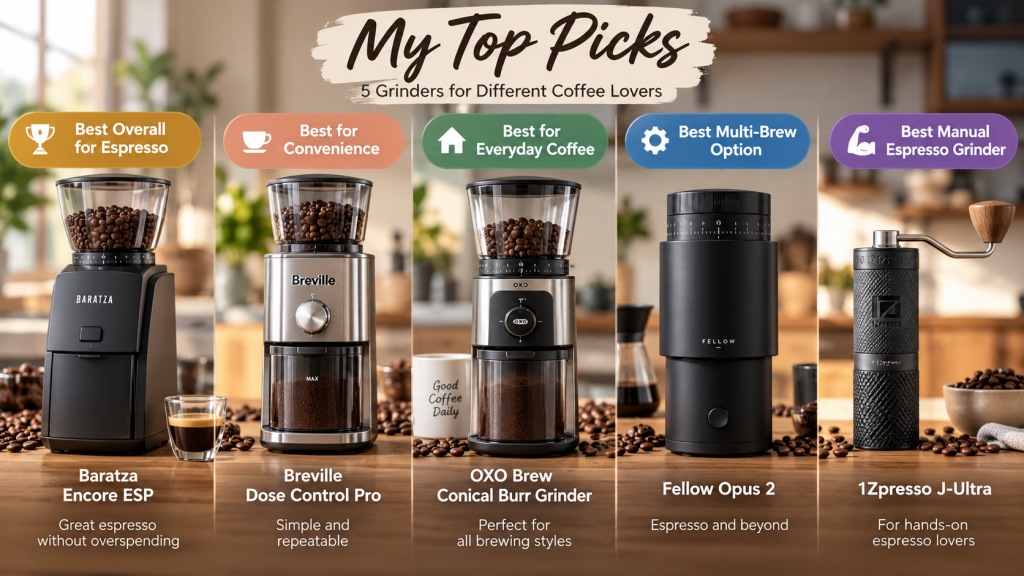
My Top Picks

After comparing the five options, these are the grinders I would choose for different types of users.

🏆 Best Overall for Espresso

Baratza Encore ESP

The strongest starting point for most beginners who want good espresso without overspending.

☕ Best for Convenience

Breville Dose Control Pro

A practical choice if you want a straightforward, repeatable daily routine.

🏠 Best for Everyday Coffee

OXO Brew Conical Burr Grinder

A good fit for households that make different types of coffee rather than espresso exclusively.

🔧 Best Multi-Brew Option

Fellow Opus 2

A more refined option if you want espresso capability plus strong performance across other brewing methods.

💪 Best Manual Espresso Grinder

1Zpresso J-Ultra

For espresso enthusiasts who don’t mind doing the grinding themselves.

Final Verdict

You don’t need to spend hundreds and hundreds of dollars on a coffee grinder to make excellent espresso.

What you need is a grinder that gives you:

  • Consistent grinding
  • Enough espresso adjustment
  • Repeatable results
  • A workflow you actually enjoy using

For many home baristas, the $150–$300 range is the sweet spot.

Once you move beyond that range, you’re increasingly paying for better workflow, finer control, build quality and enthusiast-level performance rather than simply getting dramatically better coffee.

So before buying the most expensive grinder you can afford, ask yourself one question:

What problem am I actually trying to solve?

If the answer is simply “I want better espresso,” you may not need the most expensive grinder on the counter.

You may just need a better-balanced setup.

5 thoughts on “Do You Really Need an Expensive Coffee Grinder for Espresso?”

  1. Pingback: Ninja Luxe Café vs. Breville Barista Express: Is the King Dead? (2026 Review)

  2. Pingback: DF54 Grinder Review: Did This $230 Grinder Kill $600 Coffee Gear?

  3. Pingback: Cheap Coffee Gear Upgrades: 3 Tools Under $25 That Fix Bitter Coffee

  4. Pingback: Bialetti Moka Express Review for Beginners: Stop Buying Cheap Gear

  5. Pingback: BYESHOP CM5822 Espresso Machine Review: Is It Worth It?

Leave a Comment

Your email address will not be published. Required fields are marked *

Scroll to Top