Do You Need a $500 Espresso Machine? My $200 Setup

Do You Actually Need a $500 Espresso Machine? The $200 Setup That Changed My Mind

Looking for a $200 espresso machine that can actually make great coffee? You might be surprised to learn that you don’t need to spend $500—or more—to build a satisfying home espresso setup.

I tested several popular entry-level options to see where your money is best spent: on the espresso machine itself, or on a better grinder and fresh beans.

You can spend $500 on an espresso machine and still make disappointing coffee. You can also spend considerably less and get a shot that makes you stop halfway through your morning routine and think, okay, that’s actually pretty good.

That is what got me thinking about the real question:

Do you actually need a $500 espresso machine?

My short answer is no.

But there is a catch.

If you’re going to save money on the machine, I wouldn’t simply buy the cheapest espresso maker I could find. I’d put more of the budget into the grinder.

And that changes the whole equation.

The $500 Espresso Machine Everyone Wants to Buy

Let’s start with the obvious comparison.

The Breville Bambino Plus BES500 currently sits at around $500 in the U.S. It is a very good-looking machine, but more importantly, it solves several problems that beginners usually run into.

It heats up in about three seconds using Breville’s ThermoJet system, uses an 18g dose with its 54mm portafilter, and has automatic milk texturing with adjustable temperature and texture settings.

It also uses low-pressure pre-infusion followed by a 9-bar extraction.

In other words, Breville isn’t charging $500 simply because the machine looks nice.

There is some genuinely useful engineering here.$200 espresso machine

But here’s where I think beginners get caught.

They buy the $500 machine…

…and then use a $50 grinder.

That’s backwards.

Your Espresso Machine Isn’t Grinding Your Coffee

This sounds painfully obvious, but it’s easy to forget when you’re shopping.

Your espresso machine can control temperature.

It can control pressure.

It can steam milk.

It can heat up quickly.

It can give you automatic shot volumes.

But it can’t fix coffee that was ground badly.

A good espresso grinder can make a bigger difference than upgrading the machine itself, especially when you’re working with a limited budget. Check out our guide to the best grind-by-weight coffee grinders if you want to understand where the extra money should go.

Espresso is incredibly sensitive to grind size. If your grind is too coarse, the water can rush through the coffee. Too fine, and the shot can choke.

And even when the grind size is technically close, inconsistent particles can make dialing in much harder than it needs to be.

That’s why I’d rather see someone buy a decent $150 machine and put another $150 into a grinder than spend $500 on the machine and then try to save money on everything else.

It’s not as exciting.

A grinder isn’t exactly the glamorous piece of equipment you show people when they come over.

But it matters.

A lot.

My $200-ish Setup

This is where the experiment gets interesting.

One machine I’d consider is the CASABREWS CM5418.

CASABREWS CM5418 Compact Espresso Machine with Milk Frothing Steam Wand

The machine is generally priced around the $140 range, although Amazon pricing can move around depending on promotions and sellers.

It has a 20-bar pump, low-pressure pre-infusion, PID temperature control, a pressure gauge, and a manual steam wand.

On paper, that’s a ridiculous amount of equipment for the money.

But I’m not going to pretend a $140 machine is secretly a $500 machine.

It isn’t.

The CM5418 uses a 51mm portafilter and comes with pressurized filters, which makes it friendly for beginners but also means you’re not getting the same enthusiast-oriented workflow as a more expensive setup.

That’s okay.

The point isn’t to pretend cheap equipment is premium equipment.

The point is to spend the limited budget where it makes the biggest difference.


What About the De’Longhi Stilosa?

The other obvious budget option is the De’Longhi Stilosa EC260BK.

It’s another entry-level machine that keeps things simple. It has a 15-bar pump, stainless-steel boiler, manual steam wand and a compact footprint.

I’ve always liked the basic idea behind the Stilosa.

It doesn’t try to overwhelm you with buttons.

It doesn’t take over your kitchen counter.

And it doesn’t pretend you’re buying a commercial café machine.

It’s a simple machine for someone who wants to start making espresso at home without turning coffee into a second job.

But if I’m building a setup specifically around getting better espresso for the money, I’d lean toward the CASABREWS CM5418 because of its PID temperature control and pressure gauge.

That’s my preference—not a universal rule.

And that’s an important distinction.

If you’re deciding between the most affordable options, our Casabrews vs. De’Longhi Stilosa comparison breaks down the differences in price, pressure, frothing, design, and everyday usability.

So Where Should the Extra $300 Go?

This is the part I think gets missed in a lot of espresso-machine buying guides.

If your total budget is $500, you have choices.

Option A

Breville Bambino Plus — about $500

And then use whatever grinder you already own.

Option B

Budget espresso machine — about $140–$150

Plus a substantially better dedicated espresso grinder.

The second setup may not look as impressive on Instagram.

But if the goal is actually drinking better espresso?

I’d take Option B seriously.

There is one huge caveat, though.

You need a grinder that can actually grind for espresso.

A general-purpose blade grinder isn’t going to suddenly become an espresso grinder because you put “espresso” in your search query.

This is one area where I would rather wait, save a little longer, and buy the right grinder than buy a cheap one twice.


The $500 Machine Still Wins at One Thing

Convenience.

And this is where I don’t want to oversell the budget argument.

The Bambino Plus is genuinely easier to live with.

Three-second heat-up is fantastic when you’re standing in the kitchen before work.

The automatic milk texturing is also a big deal if you drink lattes regularly. You can choose from different milk temperatures and texture levels instead of learning how to manually steam milk from scratch.

And honestly?

There are mornings when I don’t want a hobby.

I want coffee.

That’s where a machine like the Bambino Plus makes a lot of sense.

If you’re the person who wants to make a latte at 7:15 AM without thinking too much about it, spending more can be completely reasonable.

→ See today’s Breville Bambino Plus price on Amazon


But Here’s Where the Cheap Setup Gets Interesting

Once you start caring about espresso as a hobby, convenience becomes less important.

You start changing your grind.

You weigh your dose.

You adjust your shot time.

You taste the difference between a fast and slow extraction.

You start asking why one bag of beans tastes sweet and chocolatey while another suddenly tastes like sour fruit.

And that’s when the grinder becomes even more important.

A better grinder gives you more control over the process.

The machine still matters. Temperature stability matters. Pressure matters. The quality of the portafilter and basket matters.

But espresso is a system.

It’s not a $500 box that magically turns beans into café coffee.


What I Would Actually Buy

If I had $500 today and was starting from scratch, this is how I’d think about it.

If I wanted convenience:

Breville Bambino Plus BES500

I’d spend the money and enjoy it.

The fast heat-up, automatic milk steaming and simple controls are genuinely useful features, not just marketing extras.

→ Shop Breville Bambino Plus BES500 on Amazon

If I wanted the best value:

CASABREWS CM5418 + a better espresso grinder

This is the setup I’d be most interested in.

The CM5418 gives you PID temperature control, low-pressure pre-infusion, manual steaming and a pressure gauge at a much lower machine price.

That leaves room in the budget for the part of the setup that I think beginners underestimate: the grinder.

→ Shop CASABREWS CM5418 on Amazon

If I wanted the cheapest sensible entry point:

De’Longhi Stilosa EC260BK

It’s simple, compact and inexpensive.

If you aren’t sure whether you’re going to become an espresso person, this is probably the safer way to find out.

→ Shop De’Longhi Stilosa EC260BK on Amazon


So… Do You Actually Need to Spend $500?

No.

But I also wouldn’t say that everyone should avoid a $500 espresso machine.

That’s too simplistic.

If you value speed, consistency, automatic milk texturing and an easier learning curve, the Breville Bambino Plus makes a very strong case for itself.

If you have a limited budget and don’t mind doing a little more work, I’d rather build a balanced setup.

Machine + grinder + fresh beans.

Not:

Expensive machine + cheap grinder + stale beans.

That second setup might look better on your kitchen counter.

It won’t necessarily taste better in your cup.

And honestly, that’s the part I wish I’d understood earlier.

espresso machine under $200

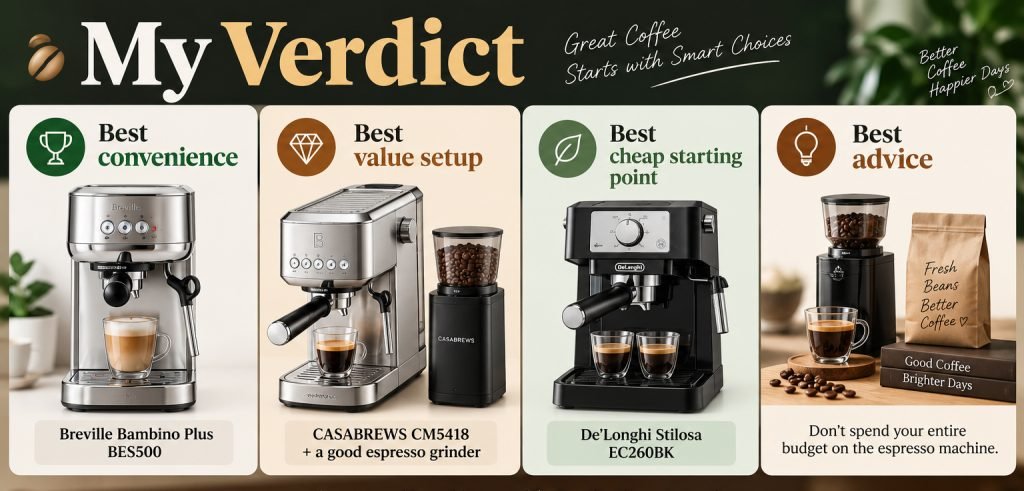
My Verdict

Best convenience: Breville Bambino Plus BES500

Best value setup: CASABREWS CM5418 + a good espresso grinder

Best cheap starting point: De’Longhi Stilosa EC260BK

Best advice: Don’t spend your entire budget on the espresso machine.

If you’re working with around $200, I’d rather see you buy a decent entry-level machine and put the rest toward a proper grinder and fresh beans.

Because the goal isn’t to own the most impressive espresso machine.

The goal is to make a cup of coffee you actually look forward to drinking.

And that’s a much better reason to spend your money.

Is a $500 espresso machine worth it?

It can be, especially if you value convenience, fast heat-up and easier milk steaming. The Breville Bambino Plus combines rapid heating with automatic milk texturing.

Yes, but your results will depend heavily on the grinder, beans, recipe and technique. A less expensive machine doesn’t automatically mean bad espresso.

The CM5418 is designed with beginner-friendly controls, dual-wall filters, adjustable shot volume and a manual steam wand. It also includes PID temperature control and a pressure gauge.

For someone who wants an inexpensive, compact manual espresso machine, the Stilosa is a sensible entry point. It has a 15-bar pump, stainless-steel boiler and manual milk frother.

For a limited budget, I’d prioritize a balanced setup rather than putting almost everything into the machine. A capable grinder is essential for dialing in espresso consistently.

2 thoughts on “Do You Need a $500 Espresso Machine? My $200 Setup”

  1. Pingback: Do You Really Need an Expensive Coffee Grinder for Espresso?

  2. Pingback: Ninja Luxe Café Pro ES701 vs Breville Barista Express BES870: Which Should You Buy?

Leave a Comment

Your email address will not be published. Required fields are marked *

Scroll to Top